
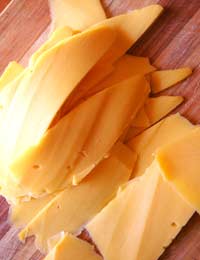
Scotland’s northern geography and temperamental climate once restricted local artisans to a rather short cheese-making season. The cheeses they produced had to withstand long winters and storing periods and hence, most traditional Scottish cheeses are of the hard, matured variety. In modern times, however, the advances of refrigeration and temperature-controlled facilities have served to boost cheese making across the country and the seasons. From small creameries to commercial manufacturers, Scotland now boasts more than two dozen cheese producers. And though the ever-popular Scottish Cheddar accounts for about 75% of total production, modern cheeses crafted by artisan and family farmhouse makers are also tempting the taste buds of many a connoisseur.
Bonchester
A modern farmhouse cheese, Bonchester is made from the unpasteurised milk of Jersey cows. The rind has aromatic hints of mushrooms, while the buttery yellow interior is more fresh and grassy. Slightly chalky when young, the cheese takes on a soft, velvety, custard-like consistency when allowed to age for a few weeks. The rich cheese is a past medal winner in the British Cheese Awards and is typically available from March to December.
Caboc (Ross-Shire)
According to an ancient recipe, this fresh cow’s cheese is made with cream-enriched milk and ripened for just five days. The result is a soft double cream log with a fat content of 69%. Rolled in toasted oatmeal, the cheese offers a combination of nutty, yeasty flavour and sharp, lemony tang. A favourite for spreading on crackers or oatcakes, Caboc is also a nice selection on a cheese board.
Crowdie (Gruth)
The Vikings introduced this soft fresh cheese to Scotland in the eighth century. Made from skimmed cow’s milk, it’s naturally low in fat with a creamy yet crumbly texture. Crowdie offers a nice lemony tang that’s favoured for cooking and eating with oatcakes. Sold in logs or tubs, the vegetarian cheese comes in several versions, including plain, peppercorn, garlic and herb.
Dunsyre Blue
Very creamy and sweet, this mild blue is made from the unpasteurised milk of Ayrshire cows. When aged, chunks of blue-green mould spice the smooth, creamy interior, and a variety of moulds can also be seen on the moist white rind. The cylinder-shaped cheese is usually wrapped in foil and is suitable for vegetarians.
Isle of Mull Cheddar
This hard cow’s milk cheese is made on the Isle of Mull off Scotland’s west coast. Crafted by the Reade family on the island’s only dairy farm, the cylindrical artisan cheese is firm pressed, wrapped in cloth and matured for 12 months in the Reade’s cellar. It’s unique in character (often compared to a fine malt) with a pale colour and tangy, spicy, malted barley flavours.
Though the texture is slightly grainy and softer than a traditional English Cheddar, the flavour is quite deep and powerful. And when it reaches a rich maturity, the cheese sometimes develops blue veins – a delicious natural perk. Isle of Mulle Cheddar is also available with flavourings of herbs, caraway seeds and peppers.
Lanark Blue
Sometimes called “Scotland’s Roquefort” this famous sheep’s milk blue is handmade in a farmhouse creamery. Sprinkled with mould before curdling, the cheese is slightly sweet and streaked with green-blue veins throughout. Lanark Blue is moulded into cylinder shapes by hand, matured for three months and wrapped in foil.
Orkney Extra Mature Cheddar
Made on the island of Orkney, this traditional creamery cheese is a favourite all over Britain. Hard and rindless, it’s nutty and creamy in flavour, offering a distinctive hint of burnt onion. The block-shaped Cheddar is typically aged between 15 and 18 months, displaying tiny crystals of calcium lactate when aged.
Seriously Strong Cheddar
This strong and savoury cheese is made with pasteurised cow’s milk from the finest farms in Dumfries and Galloway. Hard, yet moist in texture, it has a distinctive, biting flavour that hints of caramel and butterscotch. Seriously Strong Cheddar is suitable for vegetarians and is excellent for eating out of hand, melting, grilling and grating too. A version coloured with annatto is famous in Scotland, while the white variety is more popular in England. This cheese is the UK’s best-selling Cheddar.
